

A-Level Results 2026: Why the Gap Between London and the North Just Got Wider

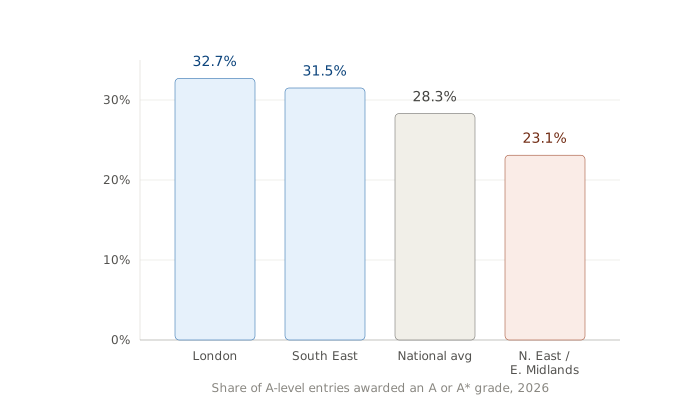
On Thursday, close to a million A-level and Level 3 results landed across England, and buried inside the headline rise in top grades was a statistic that should trouble anyone hoping regional inequality in education might finally be narrowing. The gap between London, where 32.7% of grades came in at A or above, and the North East and East Midlands, both stuck at 23.1%, has widened to 9.6 percentage points. That is the largest gap between the best and worst performing regions since the current A-level grading system began in 2010.
What results day showed nationally
Nationally, the picture looked steady rather than dramatic. The proportion of A* grades rose to 9.6%, up from 9.4% last year, and top grades overall (A and A*) edged up to 28.3% from 28.2%. Boys outperformed girls at the top end for the second year running, with 28.9% of boys' entries graded A or A*, against 28.0% for girls, a gap that has widened to 0.9 percentage points, up from 0.2 a year ago. Subject choices are shifting too: politics, law, economics and further maths all saw sharp rises in entries, while English literature, drama and some classical subjects continued to decline, alongside a modest recovery in classics linked to renewed interest in ancient literature. University admissions tightened slightly, with 78.3% of 18 year olds securing their first-choice place, down from 81.5% last year, and more students than usual accepting a back-up offer instead.
A widening gap, not a stable one
Set against that broadly steady national picture, the regional story stands out precisely because it keeps moving in one direction. A year ago the gap between London and the North East stood at 9.2 percentage points. It has now grown again. London's top-grade share rose by 0.6 percentage points on last year, while the East Midlands actually fell by 0.7 points over the same period. Only two regions in England, London and the South East (31.5%, up from 31.3% last year), finished above the national average of 28.3%. Everywhere else, a student's chances of leaving school with top grades were below the national norm, and in the North East and East Midlands, well below it. The East of England and the North West both recorded small falls in their top-grade share too, while other regions held broadly steady. There is no sign, in other words, of a single struggling region catching up on its own, or of the gap correcting itself naturally as results move year to year.
Why postcode still shapes outcomes
The reasons behind the gap are not mysterious, even if they are hard to fix quickly. Teacher recruitment and retention is patchier outside London and the South East, particularly in shortage subjects such as maths, physics and modern languages. Specialist provision, further maths classes, three-science pathways, less commonly taught languages, tends to survive where schools are large enough or well-resourced enough to offer small class sizes for niche subjects, and that tends to mean cities and affluent areas rather than smaller towns. Independent schools, which post consistently higher average grades than the state sector, are also disproportionately clustered in London and the South East, pulling the regional average upward in exactly the places already ahead.
There is also a simpler, less discussed factor: distance. A family in outer London can often choose between several sixth forms, each with a different subject offer, and get to any of them within an hour. A family in a smaller town in the North East or East Midlands may have one realistic option nearby, and if that school does not run further maths or a particular language this year, travelling somewhere else that does is rarely practical for a teenager doing A-levels alongside part-time work or family commitments. Choice narrows the further a family lives from a large city, and narrower choice tends to mean narrower subject provision.
Henri Murison, chief executive of the Northern Powerhouse Partnership, called it "disappointing" that the gap between all three northern regions and London had widened again this year. Nick Harrison, chief executive of the Sutton Trust, put the underlying concern more starkly: a young person's chances, he said, "shouldn't depend so heavily on where they go to school." Neither observation is new. What is notable is that, fifteen years into the current grading system, the gap keeps setting new records rather than settling into something predictable.
The technical education question
Set against this backdrop, the government's push to build what ministers call "true parity" between academic and technical routes takes on extra weight. T-level results grew sharply this year: 19,665 students received a T-level grade, up from 11,980 in 2025, a rise of around 65%, and the pass rate improved to 92.6%, with 68.9% achieving merit or above. Prime Minister Andy Burnham has spoken about restoring "parity of esteem" between technical and academic pathways, and new V-levels are due to sit alongside A-levels as part of that effort, alongside routes into technical careers designed to start from age 14.
The ambition makes sense on paper. Technical qualifications are, in principle, more evenly deliverable outside the traditional grammar and independent school heartlands of the South East, and a genuinely well-resourced technical route could offer strong outcomes to students in regions where sixth-form academic provision is thinner. But T-levels remain a small part of the post-16 landscape next to A-levels, and building real parity means solving the same underlying problems, teacher supply, funding, local provision, that produced this year's regional gap in the first place. A new qualification route does not automatically close an existing one.
What this means for students and families now
For a family watching this data land on results day, the regional gap can feel like something done to them rather than something they can act on. In practice, there is a narrower and more useful question worth asking: what is actually available at my child's school, and where are the gaps? If further maths, triple science or a particular modern language is not on offer locally, that is a subject access problem a school cannot always solve on its own, but it is one that additional tuition can help with, filling in exactly the specialist teaching that regional funding and staffing gaps leave thin. Blue Tutors matches students with Oxbridge graduate tutors precisely because subject depth, not just general study support, is often what is missing where local provision is stretched.
The practical window for this is narrower than it feels. A student starting Year 12 this September who discovers in Year 13 that their school's provision in a particular subject has been thin all along has very little time left to close that gap before final exams. The earlier a family checks what their school actually offers against what a target course or university requires, rather than assuming the two line up, the more options remain open. That is true whether the gap in question is a missing further maths class, limited exam board choice in a language, or simply fewer teaching hours in a subject than a neighbouring school two postcodes over provides.
None of this closes a 9.6 percentage point gap on its own, and it shouldn't have to. Responsibility for equalising opportunity across regions sits with government funding decisions and teacher recruitment strategy, not with individual families. But while that structural work plays out over years rather than months, students do not have to wait for the system to catch up before getting the specific help they need. Knowing where the gaps are, subject by subject, school by school, is the first step to closing them early, rather than discovering them on a results day years from now.