

Academies must now follow the national curriculum: what changes for parents

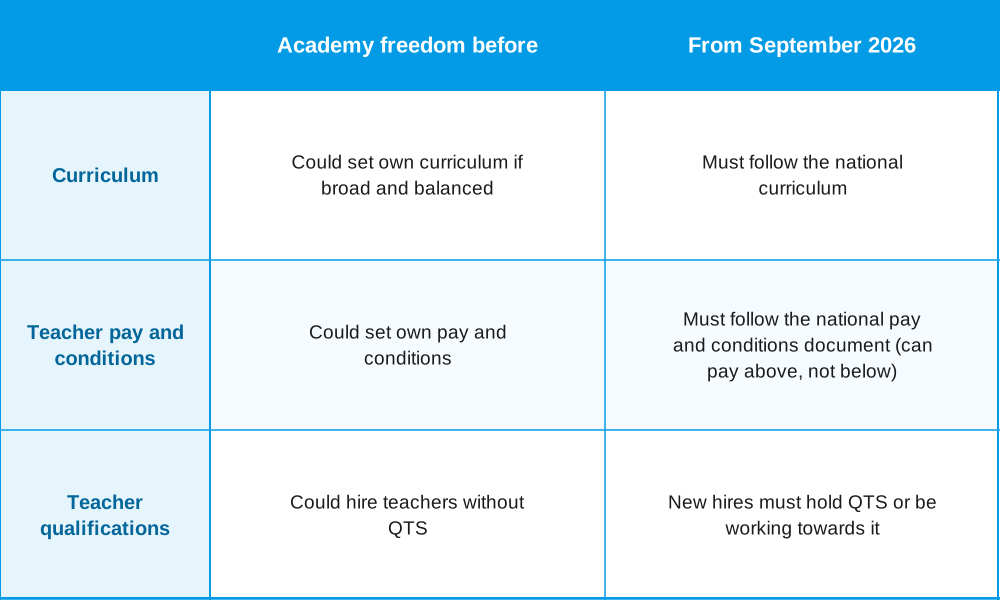
For more than twenty years, the deal with academies was straightforward. In return for taking on more responsibility for how they were run, they were given freedoms that other state schools did not have. They could shape their own curriculum, set their own teacher pay, and employ staff who did not hold a formal teaching qualification. From this September, two of those freedoms have gone and the third has been narrowed. Academies in England are now legally required to follow the national curriculum and to pay teachers according to the national framework. It is the biggest change to how academies operate since the programme was expanded in 2010.
What has changed from September
The changes come from the Children's Wellbeing and Schools Act, which became law in April 2026. Section 54 of the Act places a statutory duty on academies to teach the national curriculum. Until now, an academy trust could depart from it, provided the curriculum it offered was still judged broad and balanced. Most trusts stayed close to the national curriculum anyway, but the freedom to diverge was real, and some used it to build their own programmes of study.
Alongside the curriculum duty, academy trusts must now follow the School Teachers' Pay and Conditions Document. This is the national rulebook that sets pay scales, directed hours and working conditions for teachers in council-run schools. Trusts can still choose to pay above the national rates. What they can no longer do is pay below them, or set terms that undercut the national conditions.
In practical terms, the pay and conditions rules cover more than the headline salary. They set how many days teachers work, the protected time they get for planning and marking, a ceiling on the hours a school can formally direct, and rules around cover for absent colleagues. Trusts that had moved away from the national terms now have to bring their contracts back into line. That mostly affects staff rather than pupils, though in a school the two are rarely far apart, since teacher workload and retention feed straight back into the classroom.
The third change concerns who is allowed to teach. Newly recruited teachers in state-funded schools, academies included, must now hold qualified teacher status or be working towards it. This applies to teachers hired from September 2026 onwards. It is not retrospective, so staff already in post without QTS will not be forced to requalify, and some of the finer arrangements for academies are being phased in over the following year.
Why the government made the change
The direction was set out in the schools white paper, Every Child Achieving and Thriving, published in February 2026. Its central argument is that a child's core entitlement should not depend on the type of school they happen to attend. The government's position is that high standards and inclusion have to work together, and that a shared curriculum and a shared set of professional standards are part of how you deliver both.
The independent Curriculum and Assessment Review, led by Professor Becky Francis, had already recommended that all state schools teach the national curriculum, and the government accepted that principle in its response at the end of 2025. The Act is the mechanism that turns the recommendation into law.
The academy programme began in the early 2000s and was expanded sharply from 2010, when the argument for autonomy was at its strongest. Freedom over curriculum and staffing was meant to encourage innovation and let school leaders respond to their own communities. Ministers now take the view that consistency matters more, particularly as academies have moved from being a small minority of schools to educating most secondary-age pupils in the country.
Not everyone in the sector welcomes the shift. Some trust leaders argue that the freedoms allowed genuinely useful experimentation, and that removing them is more symbolic than practical when the large majority of academies already followed the national curriculum and national pay scales. The counterargument from government is that a right which depends on a school choosing to honour it is not much of a right at all.
How many schools this affects
The reach is wide. Academies now make up just under half of all state schools in England, but because they are concentrated at secondary level they teach a clear majority of pupils. Around 60 per cent of state school children attend an academy, and among secondary schools the figure is close to 84 per cent. For most families with a child in secondary school, the school in question is an academy, and these rules apply to it.
At primary level the picture is more even, with roughly half of schools now academies. Special schools sit between the two. The common thread is that a child's school type is often an accident of where the family lives and when the local school converted, which is a large part of why ministers wanted a single set of rules across the board.
Private schools are not affected. They set their own curriculum and their own staffing rules, and this legislation does not change that. The new duties apply to state-funded schools only.
What it means for parents and students
For many families, daily life at school will not look any different this term. If your child's academy already taught the national curriculum and already used the national pay scales, and most did, then the timetable, the subjects and the staffroom stay much as they were. The significance of the change is that these things are now a floor rather than a local choice.
That floor is worth having. If you move house, or your child changes school partway through their education, the core of what they are taught is now more predictable from one place to the next. A child's access to subjects such as science, history, geography and a modern language is protected regardless of who runs the school. And the requirement for new teachers to be qualified, or training towards it, sets a common baseline for who stands at the front of the class.
If your child is starting Year 10 this term and you are already thinking ahead to GCSEs, there is one reassurance worth stating plainly. This change does not touch exam specifications or GCSE course content. The syllabus your child began is the syllabus they will sit. If the step up to GCSE work is proving hard going, that is worth addressing directly, through the school or with extra support, but it is not something this policy affects one way or the other.
What comes next
The curriculum that academies must now follow is the current one. A full refresh is on the way, with first teaching of a revised national curriculum expected from 2028 and updated GCSEs following from 2029, both flowing from the Curriculum and Assessment Review. Public consultations on the new programmes of study and the first wave of reformed GCSEs are expected to open shortly.
So families should expect more change over the next few years. It will come in stages, with consultation at each step, rather than all at once.
For now the practical message for parents is a calm one. If your child is at an academy, the school is adjusting to a new set of legal duties, but the classroom in front of them looks much the same this September as it did last year. The larger shifts, to what is taught and how it is examined, are still a couple of years off. This term's change is mostly about making a promise explicit: that the heart of a child's education should be the same whichever state school they attend.