

Is Coursework Making a Comeback — and Is That a Good Thing?

For twenty years, the story of GCSE reform has been one direction of travel: fewer coursework projects, more three-hour papers sat in silence in a school hall. That direction may be about to bend. Professor Becky Francis's Curriculum and Assessment Review, published in November 2025 and largely accepted by the Department for Education, recommends that ministers "clarify the volume and range of coursework students are expected to produce" for GCSEs, alongside a call to cut overall exam time by at least ten per cent. For a generation of parents who only know the all-or-nothing exam hall, that is a significant shift, and not an uncomplicated one.
Why the pendulum swung towards exams in the first place
It is worth remembering why coursework was pared back so heavily after 2015. Under Michael Gove's reforms, controlled assessment and coursework were stripped from most GCSEs because of well-documented problems: schools coaching pupils through near-identical drafts, unequal access to parental help at home, and wide variation in how strictly different centres marked the same criteria. Terminal exams, whatever their flaws, at least meant every student sat the same paper on the same day, marked by someone with no stake in the result.
That trade-off has held for a decade. But it was never free. Ask any Year 11 student what they remember about their GCSE summer and few will mention a single classroom project. Most will describe six or seven weeks of back-to-back exams, each one worth the entire two-year course, with no way to recover from a bad day, a migraine, or a family bereavement that happened to fall in the wrong week. The Francis review heard exactly this concern, repeatedly, from teachers and pupils alike.
What is actually being proposed
It is easy to read headlines about "the return of coursework" and picture 2005 all over again. That is not quite what is on the table. The review's language is deliberately cautious: clarify and rebalance, not reinstate wholesale. English and History are the subjects most likely to see more structured non-exam assessment, building on project and speaking components that already exist in some specifications. Practical subjects such as PE and the sciences already carry non-exam elements, and the direction of travel there is towards protecting and formalising them rather than expanding them dramatically. Nobody serious is proposing a return to coursework counting for sixty per cent of a GCSE grade, as it sometimes did before 2015.
The more immediate change most families will notice first is the reduction in exam time itself, roughly twenty minutes off each GCSE paper, rather than a flood of new project work. Coursework reform, where it lands, is likely to arrive later and more gradually, since the review's timetable points to new specifications from September 2029 at the earliest for pupils starting Year 9 in 2026 or after.
It also helps to be specific about what coursework already means in practice, because the term covers several quite different things. In English Literature and Language, non-exam assessment currently means a small spoken language component that barely touches the final grade. In art and design, by contrast, coursework is the entire qualification, marked almost wholly on a portfolio built over two years. Combined Science already requires practical work to be logged and signed off, even though the written exam still carries all the marks. Any "return of coursework" is really a set of separate decisions about where, on that spectrum, each subject should sit, rather than one policy applied evenly across the board.
The case for bringing coursework back
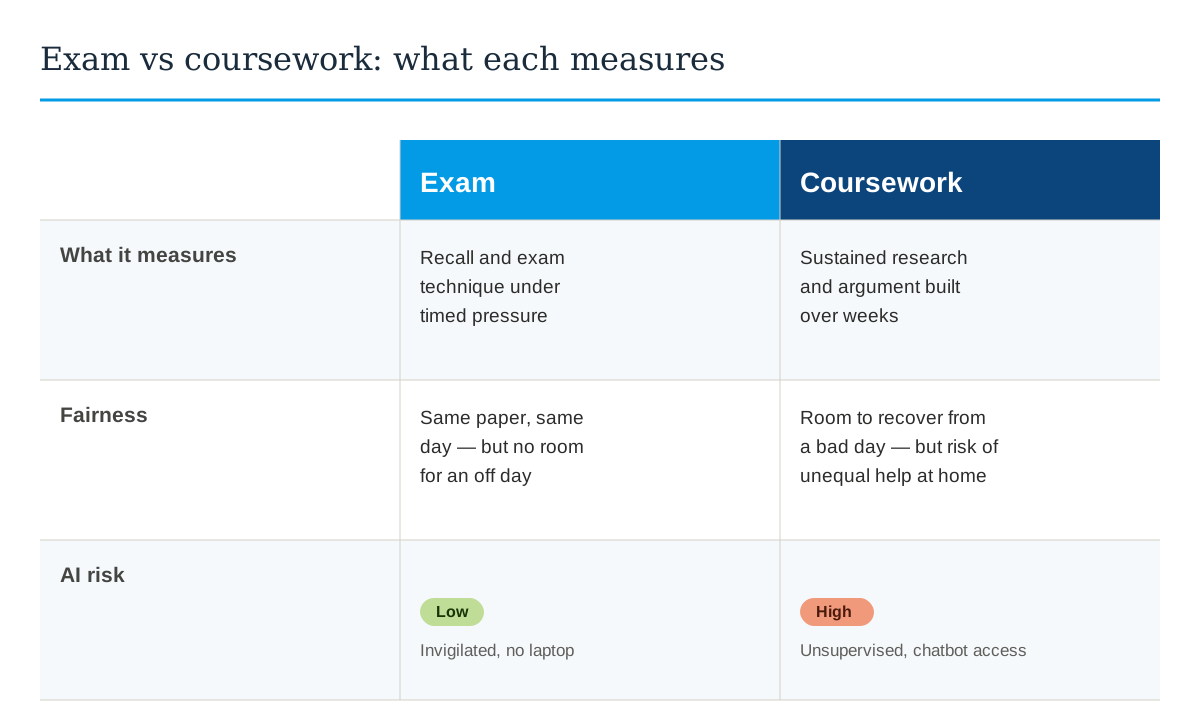
The strongest argument for coursework has always been about what it can measure that a written exam cannot. Sustained research, structured argument built over weeks rather than recalled under pressure, and the kind of independent thinking that universities and employers say they actually want. A single exam script rewards fast recall and exam technique; it says comparatively little about whether a student can plan, revise, and improve a piece of work over time, which is closer to what most further study and most jobs actually demand.
There is also a fairness argument that cuts the other way from the one that ended coursework in 2015. A student who freezes under exam conditions, whether from anxiety, a processing difficulty, or simply an off day, currently has no route to show what they know. Spreading assessment across the year gives that student a second and third chance to demonstrate the same understanding in a form that suits them better. For the many families we work with whose children are bright but exam-anxious, that alone would be welcome.
The case against, and it is a real one
The counterargument deserves to be taken seriously rather than waved away, because it is not really about 2015 any more. It is about artificial intelligence. Sir Ian Bauckham, Ofqual's Chief Regulator, has said openly that scrapping extended-writing coursework because of AI misuse is "never off the table," and that written coursework will face "far, far more scrutiny" under any reformed qualifications. The numbers explain why: in 2025 alone, 1,125 GCSE and A level cases resulted in a student losing an entire qualification for malpractice, with nearly 2,000 further cases where marks were deducted, much of it linked to undisclosed AI use in coursework-style tasks.
This is the genuine tension at the heart of the debate. Coursework is meant to reward sustained, independent effort precisely because it is done away from the exam hall. But "away from the exam hall" now means, for most teenagers, a laptop with a chatbot a click away. Ofqual's own proposed fixes, such as teacher checkpoints where students explain their sources and progress as they go, sound sensible in principle but add real workload for already stretched teachers, and they only partly solve the problem of who actually wrote the final draft.
The older fairness concern has not gone away either. A student with a quiet bedroom, a parent who studied the same subject at university, and nobody else competing for the kitchen table in the evenings still starts any piece of extended coursework with real advantages that a three-hour exam, for all its faults, does not hand out.
What this means for how tutors actually work with students
Whatever the final balance turns out to be, the shift already changes what good tutoring looks like, and in our experience matching students with tutors over the past two decades, the skills gap it exposes is not really about subject knowledge at all. Exam-focused tutoring has spent a decade optimising for one thing: timed retrieval under pressure, past papers, mark schemes, technique drilled until it is automatic. That still matters and will not stop mattering. But coursework asks for a different kind of support, one closer to how postgraduate research supervision actually works: helping a student plan a piece of extended work, structure an argument that develops over several drafts, and take feedback without simply being handed the next sentence.
That distinction matters more than it might sound. A tutor helping with coursework has to walk a careful line between developing a student's independent thinking and doing the thinking for them, especially now that schools are alert to exactly this risk. The tutors who do this well are not the ones who can produce the best model answer; they are the ones who can ask the question that gets a fifteen-year-old to notice the gap in their own argument. If coursework does expand, that kind of Socratic, developmental support, rather than answer-supply, is where tuition adds real value and where it needs to be seen doing so honestly.
There is a second, quieter shift too. If schools do start building in more of Ofqual's proposed checkpoints, regular conversations where a student explains their progress and sources as coursework develops, tutors will increasingly be preparing students for those conversations as much as for the writing itself. Being able to talk fluently about your own argument, defend a choice you made three drafts ago, and explain in your own words where an idea came from is a skill in itself, and not one that past-paper practice teaches. Oxbridge graduate tutors, many of whom sat through supervision-style questioning of their own undergraduate essays, tend to find this part of the shift second nature.
For the parent of a child starting Year 9 or 10 now, the practical advice does not change much yet. The specifications your child will actually sit are, for the most part, already fixed. What is worth watching is how your child's school talks about extended writing and independent project work over the next two years, because schools that start building those muscles early, regardless of what the final specifications say, will have pupils who cope better with whatever assessment mix eventually arrives.