

Oracy to Get Equal Status in New National Curriculum — But Consultation Slips Again

Speaking and listening are about to become as important as reading and writing on the school timetable, at least on paper. Education Secretary Lucy Powell used a speech to the Confederation of School Trusts annual conference in Birmingham on 15 October to announce that oracy, the ability to express ideas clearly out loud, will be given equal status with literacy in the overhauled national curriculum. The announcement landed the same week Tes revealed, through an exclusive, that the government's public consultation on the new curriculum has slipped again, this time to "later this year" rather than the September date ministers had been promising for months.
What the oracy pledge in the national curriculum means
Powell told the conference that oracy has been "a marker of privilege" for too long, available to pupils whose families and schools already prized debate, presentations and classroom discussion, while others left school rarely having been asked to explain their thinking aloud in a structured way. Her pledge is to make spoken language a core part of teaching and assessment all the way up to GCSE, not an optional extra bolted onto English lessons. She also linked the push to artificial intelligence, arguing that as AI takes on more of the writing and recall that schools have traditionally tested, the skills that remain distinctly human, including the ability to reason and argue a point in conversation, deserve more weight in how children are taught and judged.
This did not come from nowhere. The Curriculum and Assessment Review, the independent review led by Professor Becky Francis that reported in November 2025, had already recommended a national oracy framework, describing the evidence for its benefits to children's learning and life chances as "well established". Powell's speech turns that recommendation into a stated commitment, though the detail of how oracy will actually be taught and assessed, and whether it will carry formal marks at GCSE, has not yet been published.
Why the delay matters more than the announcement
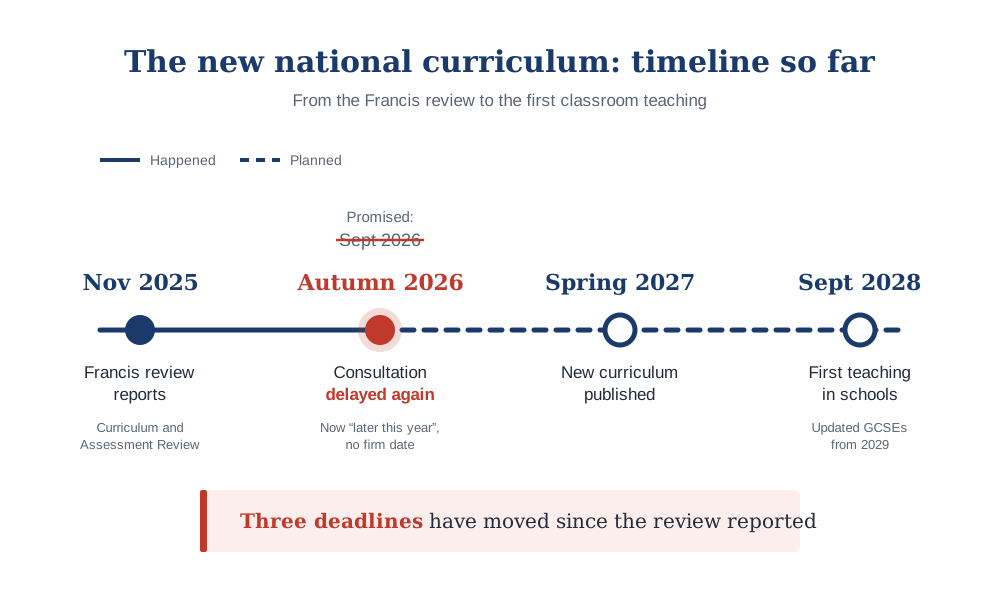
The oracy pledge is the headline, but the more consequential story for families may be the one buried underneath it. The Department for Education had repeatedly committed to publishing its draft programmes of study, the detailed subject-by-subject content for the new curriculum, for public consultation in September. Schools minister Georgia Gould said so publicly earlier in the year. That deadline has now quietly moved to "later this year", with no firm date attached, according to Tes's reporting on 16 October.
Teaching unions and curriculum specialists were blunt about what this means in practice. One curriculum drafter told Tes the government needed to stop "chopping and changing", while sector bodies called the delay disappointing. For schools trying to plan staffing, resources and training around a curriculum that is meant to be taught from September 2028, every slipped deadline compresses the time they have to prepare once the detail finally arrives.
The broader timeline, set out in the government's response to the Francis review last November, still stands for now: a new curriculum published in spring 2027, first teaching in English primary and secondary schools from September 2028, and updated GCSEs following from 2029. That gives schools roughly a year between publication and rollout, which was already a tight turnaround before this latest delay ate into the consultation window that was supposed to shape the final version.
A curriculum built differently
One detail worth noting for anyone picturing a straightforward rewrite of the current curriculum: the new version is being built as a fully digital product from the start, designed to show the links and progressions between subjects and across key stages rather than treating each as a self-contained document. That matters for oracy specifically, since a skill meant to run through every subject, from arguing a point in history to explaining a method in maths, is easier to embed coherently in a curriculum designed to show those connections than in the current set of separate subject documents.
Not everyone is convinced
The announcement has not gone unchallenged. Critics on the right of the education debate have accused Powell of downgrading written English in favour of what one commentator dismissed as "Orwellian" social engineering, arguing that a focus on spoken confidence risks softening the rigour that GCSE English and the wider curriculum reforms were supposed to protect. Others worry about a more practical problem: speaking skills are far harder to assess fairly and consistently than a written exam script. GCSE English already includes a spoken language component, assessed by teachers in the classroom rather than an external exam board, and it carries no marks towards the final grade, appearing only as a separate pass or fail endorsement on the certificate. If oracy is to carry genuine weight rather than sit alongside the qualification as a footnote, the government will need to explain how examiners can judge a conversation as reliably as they judge an essay, and do so without ballooning the workload on classroom teachers who would likely be asked to do much of that assessing themselves.
What this means for families right now
For a parent with a child currently in Year 7 or 8, the practical answer is: not much changes this term, but it is worth watching. The pupils who will sit the first GCSEs under any revised specifications are, on the current timeline, likely to be those starting secondary school from September 2028 onwards, with updated GCSE content following from 2029. Pupils already partway through secondary school should not expect their current GCSE subjects to change shape.
What is already true, regardless of when the consultation lands, is that confidence speaking about a subject tends to go hand in hand with understanding it. Tutors who work one-to-one with students often notice that a child who can explain a maths method or argue a point in an essay out loud, in their own words, is usually closer to genuinely grasping it than one who can only reproduce a written answer. At Blue Tutors, that kind of verbal back-and-forth, a tutor asking a student to talk through their reasoning rather than simply checking the final answer, has always been part of how sessions work, long before any curriculum document made it official policy.
The more immediate thing to watch is not oracy itself but whether the government can hold a date this time. Three deadlines have now moved since the Francis review reported almost a year ago. Families, schools and tutors alike are left working from the same broad outline, a 2027 publication and a 2028 rollout, without yet knowing the content that will actually fill it in.
There is a reasonable parallel worth keeping in mind while the detail is worked out. Oracy programmes already exist in pockets of the English system, usually run by individual schools or trusts that have invested in them voluntarily, often inspired by the charity Voice 21, which has spent over a decade building classroom approaches to spoken language. The schools that have taken it seriously tend to report the same thing: pupils who struggled to get started on a written answer could often talk their way to the same idea out loud first, and once they had said it, writing it down became far easier. Making that approach universal, rather than dependent on which school a child happens to attend, is the actual promise behind Powell's announcement. Whether the funding and training to deliver it arrives alongside the policy, rather than after it, is the detail that will decide whether this becomes a genuine shift in how children are taught or another well-intentioned line in a curriculum document that schools are left to interpret for themselves.