

New Vocational GCSEs to Replace Technical Awards from 2029

From 2029, a new qualification will sit alongside the GCSE your teenager already knows: the Vocational GCSE. Announced this week by the Department for Education, it is designed to give hands-on, career-focused subjects the same national standing, and the same rigorous grading, as English, maths and the sciences.
For years, technical qualifications taken at 16 have occupied an odd space in the system. Around 45% of state-funded secondary pupils took at least one technical award in 2024-25, and roughly 90% of mainstream English schools offered them. Yet these awards vary enormously from one exam board and school to the next, with no nationally agreed content and, crucially, no guaranteed route onward. A "Distinction" in one provider's construction award has never quite meant the same thing as a "Distinction" in another's. That inconsistency has made it hard for universities, colleges and employers to know what a grade is really worth, and hard for parents to judge whether a course will actually open doors.
What is changing
The new Vocational GCSEs are intended to close that gap. They will be the same size as a standard GCSE, with content set nationally rather than left to individual providers, and assessment and grading regulated by Ofqual to what the government describes as "full parity with traditional GCSEs". Proposed subjects include Business Management and Finance, Creative Media Production, Digital Tech, Child Development, and Building and Construction, chosen to reflect sectors where England has struggled to build a steady pipeline of skilled workers.
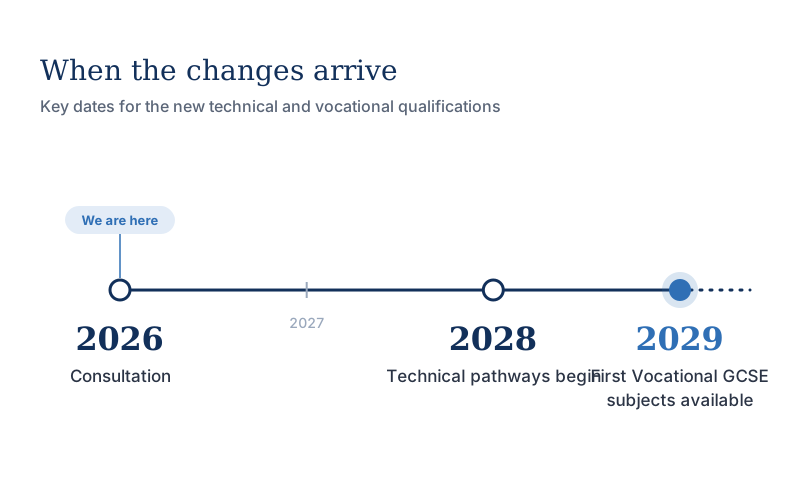
The timeline is not immediate. Broader technical pathways begin in September 2028, with the first Vocational GCSE subjects following in September 2029, alongside a public consultation due later this year. A student starting Year 7 this September could plausibly be among the first to sit one, but a student already partway through key stage 4 will finish on the current system of GCSEs and technical awards unchanged. For most families currently navigating GCSE options, this is a change to watch rather than to act on yet, though it is worth knowing it is coming, and worth asking a school what its own plans are once the consultation closes.
How it fits alongside T-levels and V-levels
The Vocational GCSE is not being introduced in isolation. It is meant to slot into a wider ladder of technical qualifications that has been under construction for several years: T-levels, the two-year, largely classroom-and-placement-based alternative to three A-levels, and the newer V-levels, a more flexible single-subject option announced more recently for post-16 study. Assessment for the new GCSEs will be "aligned to 16 to 19 progression routes including A-levels, T-levels and the new V-levels", according to the DfE, which is the detail that matters most for planning ahead. A qualification taken at 16 is only as useful as where it leads, and the stated aim here is that a good grade in, say, Digital Tech should point clearly towards a T-level, a V-level or a related A-level, rather than leaving a student to explain to a sixth form or college why their qualification does not obviously connect to anything else on offer.
Why now
The reform sits within a wider push on vocational education. Prime Minister Andy Burnham framed it bluntly: "That one-size-fits-all approach isn't working, so we're building an education system that values both academic and technical paths." Education Secretary Lucy Powell was careful to frame it as an addition rather than a diversion, insisting "this is not about creating different routes for different children." The government has paired the announcement with a National Mission on Work Experience, aiming to create 200,000 additional placements for 14 to 16 year-olds, and has pointed to the roughly one million young people currently not in education, employment or training as part of the case for change.
There is also a skills-shortage argument underneath the policy. Construction, digital and creative industries have all reported long-running difficulty recruiting at entry level, and ministers are betting that a credible, well-recognised school-leaving qualification in these areas will feed more school leavers into industries that currently rely heavily on apprenticeships and further education colleges to build a workforce almost from scratch. Whether a GCSE-shaped qualification, sat at 16 alongside nine or ten other subjects, is the right vehicle for that is precisely the question the consultation is meant to test.
The concerns worth knowing about
Not everyone is simply celebrating. Researchers at the National Foundation for Educational Research have warned that the reform could widen socio-economic inequalities if take-up stays low or uneven. Their concern draws on international evidence that earlier tracking between academic and vocational paths tends to entrench existing gaps, since choices made younger are more likely to reflect prior attainment and family background than genuine aptitude or interest. The government insists it has no plan to formally split students into academic and vocational tracks at 14, but the researchers point out that in practice, a meaningful expansion of vocational options at that age could produce something close to that effect, particularly if the range of subjects on offer differs sharply between schools and regions. A school in an area with strong construction or creative industries links may build out a rich offer; a school without those local ties may end up offering only one or two of the new subjects, or none at all.
School leaders' unions have raised a more practical worry: delivery. ASCL general secretary Pepe Di'Iasio called the reforms "well-intentioned" but stressed that schools will need proper staffing and resources to teach them well, echoed by NEU general secretary Daniel Kebede, who said success would depend on "sustained investment, resources, time and capacity." Specialist teaching staff for subjects like Building and Construction or Creative Media Production are not always easy for schools to recruit or retain, and a nationally set curriculum will only raise standards in practice if enough schools can staff it properly. NAHT's Paul Whiteman struck a more optimistic note, suggesting that, done properly, the new qualifications could "boost the status and esteem" of vocational routes, provided the reform avoids repeating the pitfalls that have dogged some existing GCSEs, where a good headline grade has not always translated into a genuinely useful, widely understood qualification.
What it means for families
For a parent with a child several years off their GCSE options, the practical takeaway is reassurance rather than urgency: a genuinely rigorous, nationally recognised vocational route is being built, rather than schools being left to patch together their own version of one. For a family with a teenager more drawn to design, construction or digital skills than to essay writing, that matters. A qualification with real national standing, properly graded and clearly linked to further study or an apprenticeship, is a meaningfully different proposition to today's patchwork of technical awards, and it gives families a genuine third option to weigh alongside the traditional academic GCSE route and the earlier move into a vocational college place.
The detail will take shape over the next few years, through the consultation later this year and the first cohorts to actually study the new pathways from 2028. Families with children currently in primary school or early secondary years have time to watch how individual schools respond, which subjects they choose to offer, and how universities, colleges and employers begin to talk about the new grades once real students start earning them. At Blue Tutors, we will be watching closely too, to understand how the new grading and content compare with existing GCSEs, and what that means for the students and families we support, whichever route best suits them.