

The Curriculum Review: What the New GCSE Specs Mean for Students

Something structural shifted in England's education system in November 2025. The Curriculum and Assessment Review, led by Professor Becky Francis, delivered its final report, and the government accepted the majority of its recommendations. For the first time since 2013, the national curriculum and GCSE assessment framework are being redesigned from scratch.
The changes won't arrive all at once. They roll out in stages, and which ones affect your child depends almost entirely on what year group they're in right now. But the direction is confirmed, the timelines are set, and for any student currently in Year 9 or younger, there's a real chance they'll sit GCSEs that look noticeably different from the exams students are sitting today.
Here is what has been decided, what is still being worked out, and what it means in practice.
What's Already Changing: Formula Sheets and English Tweaks
Some changes are in place for students sitting GCSEs in summer 2026 and 2027, before the larger reforms arrive.
The most significant near-term shift is the introduction of formula sheets in mathematics and equation sheets in physics and combined science. From this summer, students will no longer need to memorise long lists of formulas under exam conditions; a printed reference sheet will be provided in the exam room. This has been widely supported. In the consultation preceding the decision, 94% of respondents backed continuing the formula sheet in maths and 95% supported the equation sheet in physics and combined science. The aim isn't to make the exams easier. It's to shift the emphasis from rote recall towards applying knowledge, which most teachers, and most evidence, suggests is a more meaningful test of genuine understanding.
AQA has also made adjustments to its GCSE English Language paper for 2026. Paper 1, Question 1 becomes multiple-choice; Question 3 will now ask students to focus on a single effect rather than a series; Question 5 makes clear that students can write an opening rather than a complete narrative. These are light-touch changes, designed to improve clarity and reduce the risk of students misreading what's being asked.
For students in Year 10 or 11, these are the changes that matter most right now.
The Bigger Reforms: What the Review Decided
The Curriculum and Assessment Review's central argument was that England's education system had become over-indexed on exam performance at the expense of broader learning. Too much time spent preparing for too many exams. Too narrow a range of subjects incentivised. Too little space for the kinds of thinking that serve students after they leave school.
The government broadly agreed. Several headline changes are now confirmed.
GCSE exam time will be cut. The review recommended reducing total GCSE exam time by at least 10%. Ministers settled on a more modest figure, approximately two and a half to three hours per student on average, but this still represents a real reduction in the volume of terminal assessment. Less time in the exam hall means more time in the classroom, and in theory more space for depth over coverage.
The EBacc will be scrapped. The English Baccalaureate, a performance measure introduced in 2010 that tracked how many students entered GCSEs in English, maths, science, history or geography, and a language, will be abolished. Schools and arts educators have long argued that the EBacc, however well-intentioned, squeezed creative and vocational subjects out of many timetables. Its removal gives schools more flexibility over which GCSEs students take, and should ease the pressure that has seen declining uptake in arts subjects over the past decade.
Oracy gets a formal framework. One of the review's stronger recommendations is to treat speaking and listening as a genuine academic discipline, not just a soft skill. A national oracy framework will be introduced and embedded across subjects, rather than sitting purely within English lessons. This is a meaningful shift in emphasis. The evidence that oracy supports attainment across the whole curriculum, in sciences, humanities, and maths, not just English, is well established, and giving it formal status in the curriculum is a long-overdue step.
Creative subjects and enrichment get more protection. Schools will be required to provide a statutory entitlement to enrichment activities, including arts, music, drama, sport, and cultural visits. This won't guarantee a drama GCSE in every school. But it does establish a clearer expectation that these subjects are a core part of education, not optional extras to be quietly removed when timetables come under pressure.
Computer science will be replaced by a broader computing GCSE. The current specification has drawn criticism for being too narrowly focused on programming, at the expense of wider digital literacy. A broader computing qualification is planned. The review also recommends exploring a new qualification in data science and artificial intelligence for 16-18-year-olds, a recognition that these skills are increasingly central to almost every career path.
History and science content will be trimmed. Both subjects came up repeatedly in the review's findings on curriculum overload. The Institute of Physics noted that the current science curriculum leads to "superficial coverage and excessive memorisation." History faces a similar diagnosis. Reducing content isn't about lowering standards, it's about creating space for students to engage more deeply with what they do study, rather than racing through a checklist of topics in order to get everything covered before exam season.
Religious Education will become mandatory at GCSE level. Schools that had made RE optional at Key Stage 4 will need to find space for it in the curriculum.
When Do the New Specs Actually Arrive?
This is the question parents most need to understand, and the honest answer is: later than many people assume.
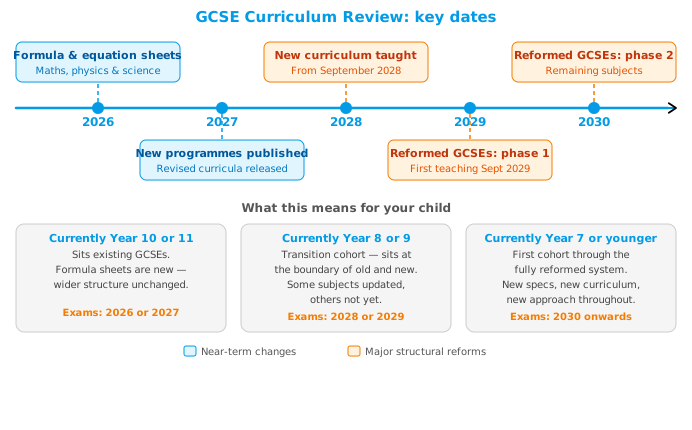
New programmes of study will be published in 2027. Schools will be expected to begin teaching the revised national curriculum from September 2028. The reformed GCSE specifications, the actual content and assessment structure, won't begin first teaching until September 2029 at the earliest, with a second phase of subjects following in September 2030.
In practical terms, what does this mean for different year groups?
Students currently in Year 10 or 11 will sit the existing GCSE specifications. The formula sheets are new; the wider structure of their exams is not.
Students entering Year 9 in September 2026 are in an interesting position. They'll be in Year 11 in 2028, just as the new national curriculum becomes mandatory across schools. They'll sit their GCSEs in summer 2029, exactly the moment when first teaching of reformed specifications begins for the cohort behind them. Some subjects may have been updated; others won't yet have been. This cohort sits at the transition between the old system and the new.
Students who are currently in Year 7 or younger will be the first to move through a genuinely reformed system from the start.
What Families Can Do Now
For students with exams approaching this summer, one practical step stands out: become fluent with the formula sheet. It's there to free up working memory during the exam, but only if students have practised using it accurately under time pressure, rather than treating it as a backup they'll figure out on the day.
For parents of younger students, the broader signals from the review are worth paying attention to. Oracy, critical thinking, creativity, and digital literacy are moving closer to the centre of what English education expects students to demonstrate. These aren't at odds with academic ambition, increasingly, they're part of what it means.
At Blue Tutors, we work with students across a wide range of year groups and subjects. The direction of the curriculum review reflects something tutors have always understood: that building genuine understanding, the kind that allows a student to explain an idea, apply a formula in an unfamiliar context, or argue a position with evidence, serves students far better than the ability to reproduce memorised content under pressure. The new GCSE specifications, when they arrive, are likely to reward exactly that kind of thinking.
The changes are real and they are coming. For most students currently in school, they'll arrive gradually. But the system that greets children entering secondary education over the next few years will be meaningfully different from the one that exists today, and in most respects, more demanding in the ways that matter.