

One Million Young People NEET: What Powell's 'Rewiring' Plan Means for Students

More than a million young people in England are now classed as NEET, not in education, employment or training, the highest total since 2013. Education secretary Lucy Powell says the figures justify what she calls "rewiring the entire education system," and the plan taking shape could change how schools balance academic and technical routes for years to come.
For a parent watching a child move through Key Stage 3 or choosing GCSE options, this can sound abstract. But the direction of travel matters. If the government follows through, it will reshape what schools are measured on, how early "risk" is flagged, and how seriously technical and vocational routes are treated alongside traditional academic ones.
What the NEET data actually shows
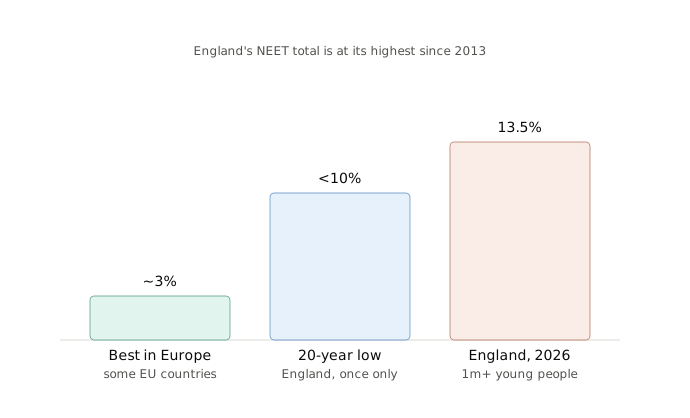
The NEET rate now stands at 13.5%, according to the Centre for Social Justice's July 2026 report Rewiring Education, with roughly 91,000 more young adults out of work, education or training since 2024. Three in five of those young people have no qualifications beyond GCSE level. The figure has crossed one million for the first time since 2013, and the report notes that England's NEET rate has fallen below one in ten only once in the last two decades, compared with rates as low as three in a hundred in some European countries.
Powell has linked the numbers directly to how schools operate day to day. "Too many young people's life chances are being determined by their lowest point in school," she said. "Disadvantage is being entrenched, and young people are working against the odds before they've even got going." Her response, in her words, is that "we're rewiring the entire education system, to give young people from all backgrounds the chance to thrive."
Catching risk earlier: Milburn's primary school proposal
A parallel strand of this comes from Alan Milburn, whose review has recommended that primary schools begin flagging children at risk of becoming NEET well before secondary school. His argument, drawn partly from a fact-finding visit to the Republic of Ireland, is that disengagement from education often starts years earlier than the age it tends to get noticed.
The evidence behind this is striking. A study in Bradford found that children who were not judged "school-ready" at age four or five were almost three times more likely to become NEET by 16 or 17. Persistent absenteeism carried an even larger risk, young people with poor attendance records were found to be nearly four times more likely to end up NEET. Under Milburn's proposal, schools in England would be expected to flag this risk from the end of primary school, drawing on attendance data and similar indicators. A small number of schools already use so-called RONI (risk of NEET indicator) tools, but the practice is far from universal.
The bigger technical education push
Powell's language sits inside a wider reform effort associated with the Prime Minister, Andy Burnham, who has made technical education a central plank of his approach to schools policy. The Centre for Social Justice report that prompted this week's coverage calls for a nationally recognised Technical Baccalaureate starting at age 14, combining English, maths and science with subjects like engineering, construction and computing, designed to feed into T Levels, apprenticeships and skilled employment rather than sitting apart from them.
Two other developments this week point the same way. Regional mayors look set to take control of sixth form funding, with a full timetable expected at the autumn budget, a change that would hand local leaders more say over how post-16 provision is shaped in their area. And Ofsted has indicated it would fold any Burnham-driven reforms into its existing annual "update process" rather than rebuild its inspection framework from scratch, suggesting the government wants change to arrive through the current system rather than a disruptive overhaul.
How this could land in the classroom
If Milburn's flagging proposal is adopted in something close to its current form, the practical change for most primary schools would be a shift in what already gets recorded. Attendance, engagement in lessons, and progress against expected standards are all tracked already; what would change is that this data gets pulled together into a single risk picture for each child, reviewed well before the move to secondary school rather than only when a problem becomes obvious in Year 9 or 10. Some multi-academy trusts have piloted versions of this using RONI-style scoring for a few years, and the government's interest suggests it wants to take whatever works from those pilots and apply it more widely, rather than invent something from scratch.
On the technical education side, a Baccalaureate-style qualification from age 14 would be a bigger structural change, and a slower one. Any national rollout would need new specifications, trained staff, and industry partnerships in the specific sectors each area wants to feed into, none of which happens in a single school year. The autumn budget is the moment to watch for a firmer timetable, particularly on the funding side, since sixth-form devolution to mayors and any new technical qualification will both need money attached before schools can plan around them with any confidence.
Not everyone agrees on the cause
The scale of the NEET rise is not in dispute, but the explanation is. Critics have pointed out that the recent surge coincides with a period in which the number of NEETs was previously at its lowest for decades, and argue the causes lie as much in the labour market as in schools, the rising cost of employing young workers, a tightening entry-level jobs market, and a sharp increase in the number of young people reporting mental health difficulties that keep them out of work or study. Whether the fix genuinely lies in "rewiring" schools, or in factors largely outside them, is likely to remain a live argument as the policy develops.
What it means for families right now
None of this changes GCSE or A-level content overnight, and Powell's own department has said there are no plans to reopen the current curriculum and assessment review while these ideas are worked through. But the signal to families is clear enough: technical and vocational pathways are being positioned as equally serious choices, not fallback options, and schools may soon be expected to track engagement and attendance more closely from a much younger age than before.
For a student who is coping well with GCSEs, that's mostly reassuring, it points to more options at 16 and 18, not fewer. For a student who is starting to disengage, whether through patchy attendance, low confidence in a particular subject, or simply losing interest, it's a reminder that early, consistent support tends to matter more than a late intervention once a pattern has set in. That's exactly the gap regular one-to-one tuition is often used to close, and it's worth keeping an eye on how these reforms take shape over the coming months, particularly around the autumn budget when more detail on funding is expected.