

What Makes a Great Tutor? It's Not What You'd Expect

Ask most parents what they want in a tutor and the answer comes back quickly: a first-class degree from a top university, ideally in the exact subject their child is studying. It feels like the safe choice. Yet after two decades of matching students with tutors, we have found that what makes a great tutor has surprisingly little to do with the degree on the certificate.
Private tuition is now a mainstream part of English education. According to the Sutton Trust's 2026 research, 29 per cent of secondary school pupils have had a private tutor at some point, a figure that rises to 45 per cent in London and peaks in Year 11. With so many families paying for tuition, often at real financial stretch, the question of what actually makes it work matters.
When a parent first contacts Blue Tutors, many of them ask straight away where our tutors studied. It is an understandable question. A strong academic record is easy to check, easy to compare, and feels like a guarantee. If someone scored a grade 9 in GCSE maths and went on to read the subject at Oxford, surely they can help a fifteen-year-old who is stuck on quadratic equations.
Sometimes they can. Often, though, the thing that was stopping that fifteen-year-old had nothing to do with quadratics.
The credential trap
There is a well-known problem in teaching called the curse of knowledge. Once you understand something deeply, it becomes very hard to remember what it felt like not to understand it. The steps you skip without noticing are exactly the steps a struggling student needs to see. A tutor with a spectacular grasp of their subject can, oddly, be worse at explaining its foundations than someone who found it harder themselves and had to work out how to make it click.
We see this pattern regularly. A tutor arrives with an immaculate transcript and cannot understand why the student is not keeping up. They have never had to break the subject down, because for them it was never broken. The tutors who tend to get the best results are often the ones who remember struggling, and who built a set of explanations to climb out of it.
What actually makes a great tutor, according to the evidence
The headline research on tuition is genuinely encouraging. The Education Endowment Foundation, which reviews the evidence behind different approaches to teaching, rates one to one tuition as high impact and finds it delivers around five months of additional progress on average. That is a large effect for a single intervention.
But read the same research closely and a caveat appears. The EEF is clear that the effect depends heavily on how the tuition is delivered, on whether sessions are properly linked to what the student is doing in class, and on the skill and training of the person teaching. Raw subject expertise is not on that list. What matters is the quality of the interaction.
Decades of classroom research point the same way. A large review synthesising more than seventy years of studies, covering millions of pupils, found that the quality of the relationship between teacher and student is consistently linked to both engagement and achievement, with the effect on engagement especially strong. A child who trusts the adult in front of them, who feels safe being wrong, will attempt more, ask more, and stay with a hard problem for longer. A child who feels judged goes quiet.
Communication is a skill of its own
One of the more surprising findings in the research on effective tutoring is that the best tutors talk less. They resist the urge to lecture. Instead they ask questions, wait, and get the student to explain their own thinking out loud. The explaining is where the learning happens. A tutor who fills every silence with their own voice, however brilliant that voice is, does the mental work that the student needs to be doing.
This is a learnable skill, but it is not the same skill as being good at the subject. It involves reading a room of one. Noticing the small hesitation that means a student has lost the thread. Knowing when to offer a hint and when to let someone sit with the discomfort of not knowing for a few more seconds. Choosing the one example that will land rather than the three that are technically correct.
In our experience, this is the single biggest difference between a tutor who is merely competent and one who genuinely changes a student's confidence. It has very little to do with which university they attended.
Much of the job is repairing confidence
A large share of the students who come to us are not really behind on content. They have decided they are bad at the subject. That belief does more damage than any specific gap, because it stops them trying, and not trying guarantees the gap grows. Undoing it is slow work. It happens through small, repeated experiences of getting something right and being noticed for it.
A tutor who leads with their own brilliance can make this worse. The student sees the distance between themselves and the expert and reads it as proof they will never get there. A tutor who is generous with encouragement, who points out real progress specifically rather than with vague praise, who treats the student as capable, shifts that story. The academic content is often the easy part once the student believes it is worth the effort.
Patience is a skill, not a mood
Parents often say they want a patient tutor, and they usually mean someone who will not get visibly frustrated. That matters, but real patience in teaching goes further. It is the willingness to teach the same idea four different ways across three weeks without the student sensing any impatience underneath. It is not rushing to the answer to keep the session moving. It is meeting the ninth wrong attempt with the same calm as the first.
Children are acutely sensitive to an adult's frustration, even when it is well hidden. A tutor who is quietly irritated that a point has not landed will, without meaning to, teach the student that they are slow. That lesson sticks longer than any piece of subject content. The tutors who do this work well seem to genuinely accept that repetition and dead ends are the normal texture of learning, not a sign that something has gone wrong.
Where credentials do still matter
None of this means subject knowledge is optional. It plainly is not. A tutor preparing a student for A-level further maths needs to have mastered the material well beyond the level of the exam. For Oxbridge admissions tests or olympiad-style problems, deep expertise becomes essential again, because the tutor needs to model how a strong mathematician actually thinks. The research is consistent here too. Subject knowledge and teaching skill are both necessary, and neither is sufficient on its own.
The mistake is not valuing academic strength. The mistake is treating it as the whole picture, and assuming that the more impressive the credential, the better the teaching will be. Past a certain threshold, that relationship breaks down. A tutor who understands the subject solidly and can communicate with warmth and patience will almost always outperform a more decorated tutor who cannot.
What we look for when we match a tutor
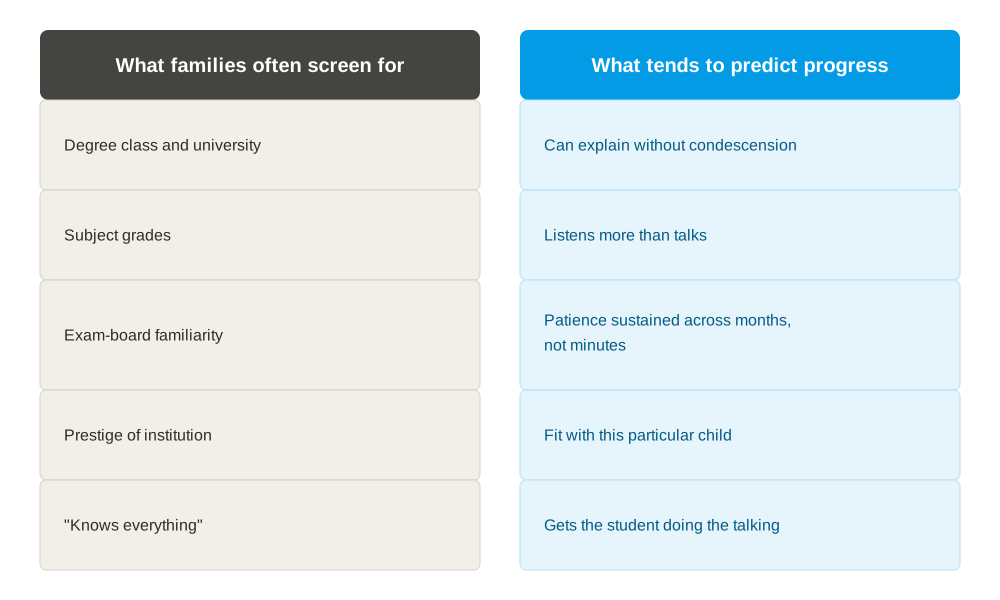
When we pair a student with a tutor at Blue Tutors, the academic filter is real, but it is only the first step. Every tutor has a strong record in the subject they teach. After that, the questions we are actually trying to answer are different. Can this person explain something without condescension? Do they listen more than they talk? Will a nervous Year 10 student feel comfortable admitting they do not understand?
We also think hard about the fit between two specific people. A confident, chatty student who responds well to being challenged needs a different tutor from a child who has lost all faith in a subject and needs rebuilding gently. The same tutor can be excellent for one and wrong for the other. That is why we spend time on the match rather than simply sending the most qualified name on the list, and why, when a pairing is not working, we would rather change it early than hope it improves.
How to tell in the first few sessions
You do not need to wait for exam results to sense whether a tutoring relationship is working. Within two or three sessions there are usable signals. Does your child talk about the tutor as a person they like? Do they come out of a session more relaxed than they went in, or more deflated? Can they show you something they can now do that they could not do before, however small? When you overhear a session, is your child doing a fair share of the talking, or is the tutor lecturing?
If those signs are good, the grades tend to follow, even if the next mock does not show it yet. If they are consistently bad, an impressive CV is not a reason to wait it out.
If your child is about to start a course that worries you, the instinct to look for the most impressive qualifications is understandable, and it is not wrong to care about them. But it is worth widening the question. Ask how a tutor explains things. Ask whether they can be patient across months, not just minutes. Ask whether your child actually looks forward to the session, or quietly dreads it. Those answers will tell you far more about the grades that follow than any transcript will.