

Should Grammar Schools Be Expanded? A Tutor's Perspective

Every few weeks, one of our tutors sits down with a ten year old who has spent the summer holidays being drilled on verbal reasoning puzzles, non-verbal sequences and creative writing prompts, all in preparation for an exam that will help decide the shape of the next seven years of their education. Whether grammar schools should expand, taking their number in England beyond the current 163, is a question that resurfaces in Parliament every few years and gets answered, in practice, by local councils quietly approving expansions to existing sites while the government insists nothing has really changed. Having spent two decades matching families with tutors for exactly this exam, we think the honest answer is no, not in the way it is currently being proposed, and not until the system around it is fixed.
The case for more grammar places
It would be dishonest to pretend the argument for expansion has no force. In Kent, Buckinghamshire and other selective areas, grammar school places are wildly oversubscribed, sometimes attracting more than five applicants for every place. Parents queue for these schools because they offer something specific: free, academically rigorous education with a track record of strong exam results and university progression, without the fees that come with independent schooling. For a family that cannot afford £18,000 a year but has a genuinely academically able child, a local grammar school can look like the only route to the kind of stretch and expectation that child deserves. We have worked with plenty of these families over the years, and their instinct, that their child needs more than a mixed-ability classroom can always offer, is not an unreasonable one.
It also helps to remember why there are only 163 grammar schools left at all, rather than the thousand or so that existed before comprehensivisation swept through England in the 1960s and 70s. Most areas voted, in effect, to close their grammar schools and mix pupils of all abilities together. The 36 local authorities that kept theirs are not a random sample. They tend to be more affluent, with parents more able to fund a tutor for the entrance exam, which is part of why the debate about expansion is so geographically lopsided. Kent and Buckinghamshire argue about how many more places they need, while most of the country stopped having this conversation fifty years ago.
Supporters also point to grammar schools' results. Pupils who attend them do, on average, achieve strong GCSE and A-level outcomes, and some research on older cohorts has found a link between grammar school attendance and higher lifetime earnings. If a policy appears to work for the children inside it, the argument goes, why not let more children benefit from it?
What the evidence actually shows
The trouble is that this argument only holds up if you ignore what happens to the other 163,000 or so children in a selective area who do not get a grammar place, and if you ignore how children end up on one side of that line rather than the other. The Education Policy Institute's landmark study on grammar schools and social mobility found no significant positive impact on social mobility from selective systems overall, and a disadvantage gap that was actually wider in selective local authorities, at 34.1%, than in non-selective ones, at 27.8%. Schools Week reported last year that £64 million handed to grammar schools specifically to make them more inclusive had, despite a pandemic-era surge in pupils eligible for free school meals, coincided with that gap widening rather than closing.
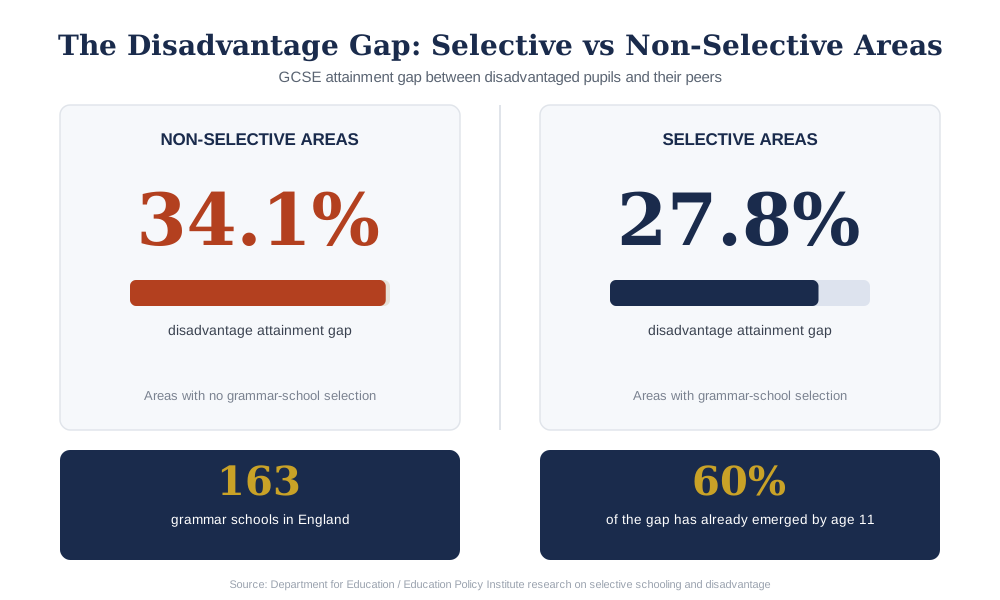
The reason is not mysterious. By the time a child sits the 11-plus, roughly 60% of the entire disadvantage attainment gap that will ever open up between richer and poorer pupils has already emerged. An exam sat at age ten or eleven is not measuring innate ability in any pure sense. It is measuring, among other things, five or six years of home environment, parental education, nursery quality and, increasingly, paid preparation. Selecting on the basis of that exam does not create a meritocratic ladder so much as it formalises advantages that were already there before the child walked into the exam hall.
The other side of the research deserves a fair hearing too. Some studies comparing grammar pupils against similarly able children at strong comprehensives have found little difference in broad GCSE outcomes, but a modest advantage further down the line, in the subjects chosen at sixth form and the universities pupils go on to. That gap post-16 is real and probably reflects the network effects of being surrounded by other university-bound peers as much as anything taught in the classroom. But it is a much narrower claim than "grammar schools improve social mobility", and it says nothing about the far larger number of children in selective areas who do not get in. Pupils also travel, on average, roughly twice as far to reach a grammar school as they do to reach a non-selective one, a detail that quietly excludes families without a car or the time for a long daily commute before a school day even begins.
The part our own industry would rather not talk about
Here we have to be honest about our own trade. Eleven-plus preparation is a substantial part of what tutoring agencies like ours do, and it exists because the test rewards practice as much as raw aptitude. A child who has worked through several years of verbal and non-verbal reasoning papers with a skilled tutor has a real, measurable advantage over an equally able child who has not, simply because pattern recognition on these question types improves sharply with exposure. Areas such as Buckinghamshire have tried to design more "tutor-proof" tests, but no test designed by adults and prepared for by children has ever been fully immune to coaching, and the families who can afford six months of weekly sessions will always be better placed to find whatever edge remains.
This matters for the expansion debate because it means simply building more grammar school places does not widen access in the way its advocates hope. It widens the number of children competing under a system that already tilts towards those who can pay for preparation, without doing anything to change who is best placed to succeed in that competition. More places, under the current admissions model, is more of the same problem, not less of it.
What we think would actually help
None of this means the underlying instinct, that able children deserve real academic stretch, is wrong. It means expansion is the wrong tool for delivering it. Genuinely need-blind outreach and free preparation for disadvantaged families sitting the 11-plus, of the kind a handful of grammar schools and charities already run, does more to level the playing field than adding extra places ever could, because it addresses the actual mechanism of exclusion rather than its symptom. So does investing in setting, enrichment and genuine academic stretch within comprehensive schools, so that a bright child in a non-selective area is not left waiting for the rest of the class before being pushed further. Ofqual and local authorities could also do more to fund independent research into which admissions test formats are least coachable, rather than leaving each selective authority to solve that problem alone with limited resources.
A few areas already show what this could look like. Some grammar schools now use "fair banding" alongside their entrance test, setting aside a proportion of places for the highest-scoring pupils within each band of prior attainment, rather than ranking every applicant against every other applicant regardless of starting point. It is not a perfect fix, but it does something expansion alone never will: it changes who gets through the door, rather than simply widening the door for the same group of children who were always going to walk through it. If expansion has to happen at all, tying every new place to a scheme like this would matter far more than the raw number of places created.
We would also like to see more transparency about outcomes for the majority of children in selective areas who sit the 11-plus and do not get a place, since the current policy conversation talks almost exclusively about the success of those who do. A system judged only by the results of its winners is not being judged fairly.
Where this leaves families
For the parents we work with each year, none of this policy debate changes the immediate decision in front of them. If your child is entered for the 11-plus in a selective area, of course you want them properly prepared, and we will keep helping families do that as long as the system exists in its current form. But we would rather see energy and public money go into making the education every child receives more stretching and more responsive, not into building more of an exam-selective system that the evidence says does not deliver the fairness its supporters promise. Genuine opportunity for able children from ordinary backgrounds is worth fighting for. We just do not think more grammar schools, as currently designed, is how you get there.