

What Oxbridge Interviews Really Test, and Why Most Students Prepare for the Wrong Thing

Every December, around ten thousand Year 13 and Year 13-equivalent students across the country log on to a video call with an Oxford or Cambridge admissions tutor, many of them having spent the autumn term trying to guess which question they will be asked. Most of that guessing is wasted effort. Oxbridge interviews are not a test of recall, and the students who treat them that way are, more often than not, the ones who come away disappointed.
We say this every year, and every year a new group of parents assumes we are being falsely modest about how hard interview preparation really is. We are not being modest. We think Oxbridge interview preparation is genuinely useful, more useful than most families realise, but only once it is aimed at the right target. Right now, with December interviews only a few days away for most applicants, that target is worth getting clear, because the wrong kind of preparation can leave a strong candidate looking weaker than they are.
What the interview is actually built to test
Oxford describes its own interviews as a short tutorial, and that description matters more than it first appears. A tutorial is not a question and answer session. It is a conversation in which a tutor pushes a student slightly further than they can comfortably go, watches how they respond, and adjusts the next question accordingly. The interview exists to show admissions tutors what that conversation would be like for the next three or four years, not to confirm what a student already knows.
This is why interview questions are so often strange. An English applicant might be asked to analyse a poem they have never seen. A physics applicant might be handed a problem that uses nothing beyond GCSE maths but combines it in a way no textbook does. A history applicant might be given a short, unfamiliar primary source and asked what it leaves out, not what it says. The content is rarely the point. What tutors are watching is whether a student can take an idea they do not yet understand, work with it out loud, and adjust course when they are told they have got something wrong.
Admissions guidance from both universities is explicit about this. Decisions are not based on a candidate's manners, appearance or background, but on their ability to think independently and to engage with new material beyond the scope of their school syllabus. That single sentence quietly rules out most of what traditional interview coaching focuses on, and it is worth every parent reading it twice.
Why rehearsed answers backfire
Admissions tutors interview thousands of candidates a year, often several on the same afternoon in the same subject. A scripted answer is not subtle, and it tends to surface in the first exchange that strays even slightly from what a candidate expected. Worse, a rehearsed response signals the opposite of what the interview is trying to find. It suggests a student who has prepared to perform rather than a student who is comfortable thinking in real time, which is precisely what the next three years of a tutorial-based degree will demand of them.
This is also why interview questions are deliberately difficult, often well beyond what the applicant is expected to answer fully. Getting to the correct answer quickly is rarely the goal, and candidates who panic when they cannot solve a problem immediately are often working from a false assumption, that the interview is measuring whether they know things. It is measuring how they behave when they do not. The students who do well are frequently the ones who say "I'm not sure, can I think out loud for a moment" rather than guessing wildly, falling silent, or ploughing ahead with a wrong assumption to avoid looking unsure.
Isn't this just natural ability?
At this point, a reasonable parent might ask whether any of this can actually be prepared for. If the interview is testing how a student thinks rather than what they have memorised, is there anything to train beyond hoping their child happens to have that kind of mind?
We think that question gets the diagnosis right and the conclusion wrong. Thinking out loud under gentle pressure, absorbing a correction without becoming defensive, staying curious when a problem will not resolve quickly, these are skills, and skills can be trained. They are simply not trained by reading a guidebook of likely questions or memorising model answers, because that approach practises the wrong thing, performance rather than reasoning, and can leave an otherwise capable student more rigid than when they started.
What does train them is repeated exposure to exactly the situation the interview creates: a conversation with someone who knows the subject well enough to genuinely push back, ask the follow-up question a textbook would not think to ask, and let a student sit with not knowing for a moment before helping them find their way through it. That is a different exercise from exam coaching, and it needs a tutor who has actually sat in that seat themselves, which is also why schools, however good, struggle to offer it at scale. A single teacher cannot run dozens of one-to-one mock tutorials in the autumn term alongside everything else on a December timetable, and a sixth form common room is not always the easiest place to practise being comfortably wrong in front of someone who knows more than you.
What the next few weeks should look like
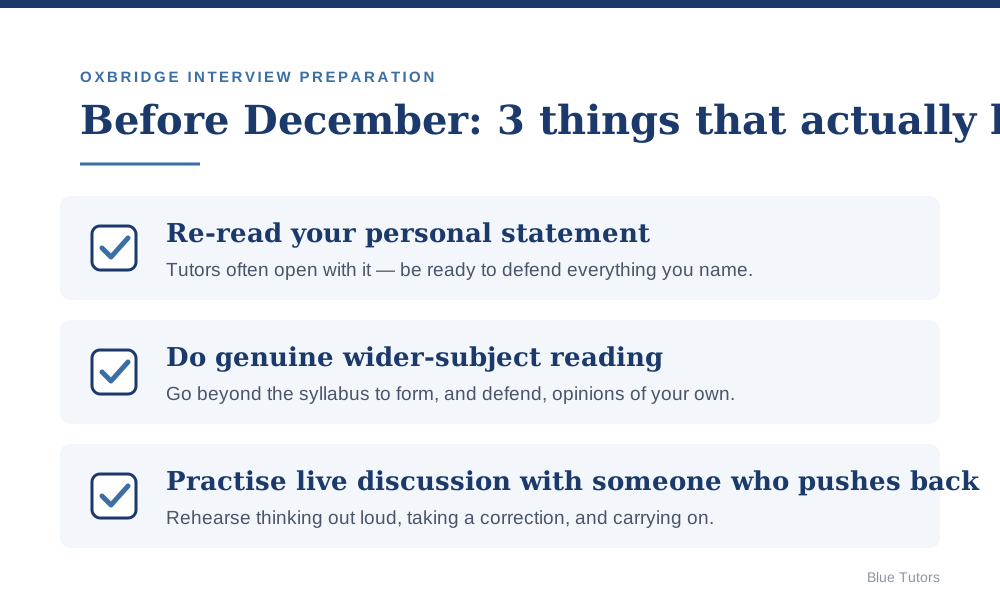
For most applicants, interviews fall in the first half of December, which puts late October and November as the window where focused preparation does the most good. Three things tend to matter more than anything else. First, re-reading the personal statement and anything named in it. Admissions tutors routinely open with a question drawn directly from it, and nothing undermines a candidate faster than being asked about a book they claimed to have read but have not, or a project they described more confidently on paper than they can defend out loud.
Second, super-curricular reading and discussion that goes meaningfully beyond the school syllabus, not to accumulate facts but to get comfortable forming and defending an original opinion about something genuinely uncertain. A student who can only repeat what their textbook says has nothing of their own to bring to the conversation, and that is usually obvious within a few minutes. Third, practice interviews with someone trained to interrupt, correct and redirect in real time, rather than simply quiz, since that is the one skill a written practice paper cannot teach, no matter how closely it mimics the real questions. There is also a role for parents here, and it is not the one most reach for instinctively. Firing GCSE-style quiz questions across the dinner table teaches a child to search for a single right answer, which is the opposite of what the interview rewards. Asking what they think about a genuinely debatable question, a news story, a book's argument, a scientific claim that sounds odd, and then disagreeing a little just to see how they respond, does far more good. It costs nothing and it practises exactly the muscle the interview will use.
It is worth adding a practical note for this year's applicants specifically. Both universities now run interviews over video call, typically through Microsoft Teams, and Oxford has been asking candidates to use the virtual whiteboard tool Miro for problem-solving questions. Spending ten minutes beforehand making sure a webcam, microphone and the software itself all work removes one more source of nerves that has nothing to do with academic ability. No family should let their child lose composure over a technical glitch that a short rehearsal could have prevented, after months of the right kind of preparation.
What we tell families now
In our experience matching applicants with Oxbridge educated tutors, the sessions that help most in the final weeks rarely look like revision at all. They look like the interview itself: a tutor setting an unfamiliar problem, letting a student struggle with it for a minute longer than feels comfortable, and then talking through not just the right answer but the thinking that gets there. Students who have practised that discomfort a handful of times walk into the real interview recognising the shape of the conversation, rather than meeting it cold. Several have told us afterwards that the real interview felt easier than the practice, which is exactly the right way round for it to feel.
If your son or daughter is one of the thousands preparing for an Oxbridge interview this December, the most useful thing you can do before half term is also the simplest. Stop adding to the pile of model answers, and start giving them practice at being wrong out loud, in front of someone who will ask the next question anyway. That is what the interview will actually ask of them, and it is the one thing worth getting right.