

Budget 2026: What It Does (and Doesn't) Mean for Schools and Families

The Chancellor, John Healey, spoke for around an hour when he delivered the Autumn Budget on 28 October. According to Julia Harnden of the school leaders' union ASCL, education did not come up once. That silence tells parents a good deal about Budget 2026 and schools. Head teachers had gone in asking for more money, and they came away with a handful of small, targeted pots of funding, a long-range forecast that has sparked talk of cuts, and several big questions about SEND and student loans still unanswered.
What schools actually got
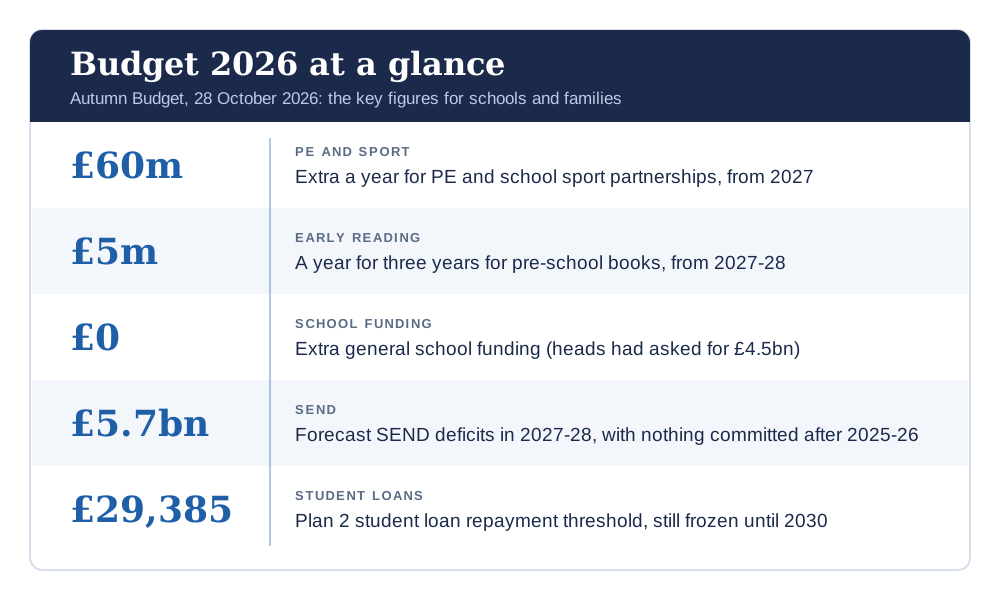
The new money for schools is modest. The Department for Education's budget for PE and sport will rise by £60 million a year from 2027, to help pay for the new PE and school sport partnerships network that starts in spring 2027. A further £5 million a year for three years, from 2027-28, will go towards getting more books into the hands of pre-school children, through organisations such as BookTrust and the Dolly Parton Imagination Library.
The PE figure needs some context. Earlier this year the government scrapped the £320 million primary PE and sport premium, which went straight to schools, and replaced it with the partnerships network, run by a national delivery partner instead of individual schools. Schools Week reported that the network will receive £580 million over seven school terms, roughly 22% less than the old premium was worth. The extra £60 million a year narrows that gap but does not close it, and many primary schools have already said they expect to cut back on sports coaching and after-school clubs.
That was more or less it for schools. Days before the Budget, head teachers had signed an open letter calling for an extra £4.5 billion to deal with what they described as huge financial pressures, including this year's pay rises and rising energy bills. No such package appeared.
Is the schools budget being cut?
Opposition politicians were quick to say so. The Liberal Democrats accused the government of real-terms cuts to schools, and a Conservative MP pointed to what he called a hidden plan for 2% a year cuts to mainstream schools after the next election. The figure behind these claims comes from the Office for Budget Responsibility (OBR), which forecasts that mainstream school spending will fall by about 2% in real terms between 2028-29 and 2031-32.
That forecast is not a decision. The OBR assumes that funding per pupil stays flat after inflation, and because pupil numbers across England have now passed their peak and are starting to fall, total spending falls with them. Luke Sibieta of the Institute for Fiscal Studies put it plainly: "This is not a planned cut to funding." The actual figures for those years will be set in next year's spending review.
For families, the more useful point is that a flat per-pupil budget is not the same as a comfortable one. Schools are already absorbing higher staff pay and energy costs from their existing budgets. When money is tight, the things that tend to get squeezed first are the extras: small-group catch-up sessions, teaching assistant hours, subject options with low take-up and enrichment activities. None of this happens overnight, but it is the direction to watch over the next two or three years.
SEND funding: the biggest gap
For parents of children with special educational needs and disabilities, Budget 2026 offered very little reassurance. Council spending on SEND has run far beyond what councils receive for it for years, and the deficits have piled up. In February the government agreed to cover 90% of the historic deficits councils had built up to the end of 2025-26, and according to Tes, councils have now received around £5.8 billion in grants to clear most of that debt.
The problem is what happens next. The government has promised to bring SEND spending into central government budgets from 2028-29, but there is no commitment to cover the deficits councils build up between now and then. The OBR forecasts that annual SEND deficits will rise from £2.8 billion in 2025-26 to £5.7 billion in 2027-28, and it describes the impact of this year's SEND reforms as "very uncertain". Analysis by the Social Market Foundation points to a funding gap of around £6 billion, with no clear answer on who will pay for it in the meantime.
This matters for families now, not just in council finance meetings. Ministers confirmed in October that the wait for an appeal over an education, health and care plan (EHCP) has reached 19 months. Councils under severe financial pressure have strong incentives to be cautious about new plans and extra support, and nothing in the Budget changes that in the short term. Parents pursuing an EHCP should expect the process to remain slow, and keeping careful records of their child's needs and the support already tried is more important than ever.
Student loans and universities
Families with teenagers heading towards university will also find little new. The repayment threshold for Plan 2 student loans, which was frozen at £29,385 until 2030 in last year's Budget, was not mentioned. The Education Secretary, Lucy Powell, has called the current system "broken and unfair" and said the Plan 2 freeze is at the top of her in-tray, but any change will have to wait. The Social Market Foundation notes that, with the National Minimum Wage now worth about £27,400 a year for a full-time worker, the two figures are on course to meet by 2030 if the freeze stays in place.
Universities got only a brief mention. The most notable change is for graduates: the planned cut to the Graduate visa, from two years to 18 months, has been reversed for graduates of what the Budget calls "high compliance" universities with "strong labour market outcomes". That matters most to international students, but it points to a wider trend worth noticing. Government policy is starting to treat universities differently depending on their graduates' results, and with competition for places at the most selective universities already well above its 2021 peak, the gap between universities is likely to keep growing.
What this means for your family
There is nothing in Budget 2026 that will change your child's school day this term. The real effects are slower and quieter. Primary schools are adjusting to less PE funding than they had before. Secondary schools face several years of tight budgets as rolls start to fall. SEND support remains under strain while the government works out how to pay for it, and families saving for university are still waiting to hear whether loan repayments will become any fairer.
The practical response is to stay informed and ask questions early. If your child needs extra help, ask the school what catch-up or small-group support is on offer and how it is changing. If your child has SEND, start conversations about support well before they become urgent. And if gaps start to open up, particularly in core subjects like maths and English where problems build on each other, a few months of focused one-to-one support with a good tutor can make up a lot of ground before it turns into a bigger problem.
The next big moment is next year's spending review, which will decide school funding from 2028 onwards. That will tell families far more about the future than this Budget did, and Blue Tutors will report on it when it comes.