

The Case for Starting Tuition Earlier Than You Think

By the time most families call a tutoring agency, the panic has already set in. It is January of Year 11, a mock exam has gone badly, and a parent is on the phone asking whether six weeks of maths tuition can undo two years of quiet drift. The honest answer is: some of it, yes. All of it, rarely. The real opportunity to change a child's GCSE story was there eighteen months earlier, and almost nobody used it.
Tutoring has become a Year 11 reflex
According to the Sutton Trust's ongoing research into private tuition in England and Wales, Year 11 is by some distance the most likely year for a pupil to receive a tutor, with around a quarter of pupils tutored that year compared to roughly one in ten in Year 10. Overall, 29% of secondary school pupils have had private tuition at some point, up from 18% when the Sutton Trust first started tracking the figure two decades ago. Put simply, tutoring in Britain has become normal, but it has become normal as an emergency response rather than a habit built early.
That timing is not an accident. Year 11 is when mock results land on the kitchen table, when UCAS and sixth form applications suddenly feel close, and when the abstract idea of "doing well at GCSEs" turns into a concrete, dated deadline. It is the year a problem that has been building since Year 9, or earlier, finally becomes impossible to ignore. But by then, a tutor is no longer building foundations. They are doing damage control.
What gets lost when tuition starts late
The Education Endowment Foundation's research on one-to-one tuition is frequently quoted, and for good reason: it finds that one-to-one tutoring can add an average of five months of additional academic progress compared with classroom learning alone. That figure tends to get used to sell tutoring as a rescue remedy, a way to claw back lost ground fast. What it actually describes is the value of focused, personalised teaching over time. Five months of progress compounds very differently depending on when it happens. Applied in Year 9, it builds a foundation strong enough that Year 10 and 11 content lands on solid ground. Applied in the six weeks before a mock exam, it is trying to plug a hole in a wall the family has only just noticed.
Crisis tutoring, by its nature, is narrow. A student arrives with a specific weak topic, a specific paper, a specific grade boundary they are trying to cross, and there is no time for anything beyond that. Algebra gets fixed, but the habit of checking working doesn't. A student learns to pass an exam without ever quite learning how to revise for the next one. Early tutoring has room to do both: teach the subject and teach the student how to learn it, which is the skill that actually carries them through sixth form, university, and beyond.
The cost of waiting is measured in more than grades
There is also a human cost to the crisis model that rarely makes it into a school report. A survey by Save My Exams found that 85% of UK students experience some form of exam anxiety, and separate teacher-reported data suggests more than a quarter of GCSE students have been withdrawn from at least one exam due to stress. Interestingly, UCL Institute of Education research has found that high anxiety about GCSEs does not, on average, translate into significantly worse grades, which suggests the anxiety itself is not simply a symptom of poor preparation. But it is very hard to convince a fifteen-year-old of that at eleven o'clock the night before a chemistry paper.
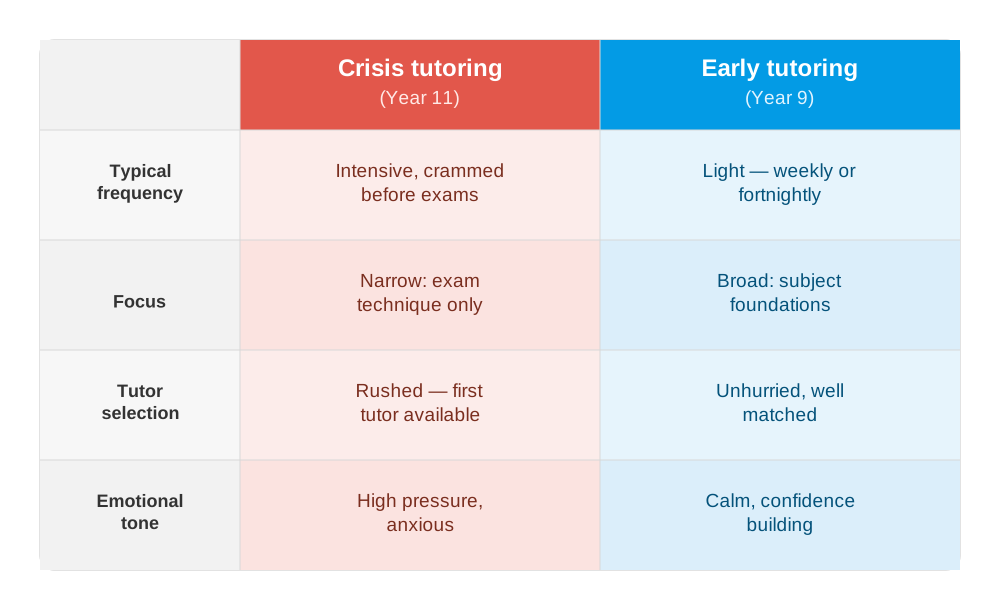
Starting tuition in Year 9, when the stakes feel lower and the clock is not yet audibly ticking, changes the emotional shape of the whole experience. A student who has spent eighteen months getting comfortable with a subject, building small wins, and normalising the idea of asking for help walks into Year 11 with a different relationship to pressure than one who is meeting a tutor for the first time three weeks before their exams begin. The work is the same. The experience of doing it is not.
The counterargument, and why it doesn't hold
The obvious objection is that Year 9 is too soon to know where help is genuinely needed, and that paying for tuition before a problem is confirmed is money spent on a guess. There is something to this. Not every child needs a tutor in Year 9, and a family should not feel obliged to start one out of anxiety rather than evidence. But the objection assumes tutoring only has value once something has gone wrong, when in our experience matching students with tutors at Blue Tutors, some of the most effective work we see is not remedial at all. It is a tutor helping a capable student build the study habits, the exam technique, and the subject confidence that make Year 11 straightforward rather than frightening. That is not money spent on a guess. It is money spent on a foundation, and foundations are cheaper to lay early than to rebuild later.
There is also a version of this objection rooted in wanting children to have a normal Year 9, free of academic pressure before it is strictly necessary. That instinct is a good one, and it points to something true: early tuition should look nothing like Year 11 crisis tutoring. It should be light-touch, occasional, and focused on building skills and confidence rather than grinding through past papers. A single weekly session with a tutor who makes maths make sense, or who helps a student find their voice in English essays, is not a burden. It is closer to the extra-curricular clubs and sports many families already sign their children up for without a second thought.
What starting early actually looks like
In practice, early tuition tends to be lighter than families expect. It is not two hours of past papers every Saturday from age thirteen. It is often a single session a week, sometimes fortnightly, in a subject where a student has shown early signs of struggling, whether that's fractions not quite clicking in Year 8 or a persistent gap in scientific method that keeps resurfacing. The goal in Year 9 is not exam readiness. It is making sure that by the time Year 10 content arrives, a student is standing on solid ground rather than sand.
This also gives families room to be selective and unhurried about finding the right tutor, something that becomes almost impossible when a mock exam has just gone badly and results day is six months away. A good match between student and tutor, someone the student actually likes working with and trusts, takes a little time to find. Families under Year 11 pressure rarely have that time. Families starting in Year 9 do.
None of this is an argument against tutoring in Year 11. Sometimes a late intervention is exactly what is needed, and a good tutor can still make a real difference in a matter of weeks. But it is an argument against treating Year 11 as the default starting point, as though tuition were only ever a response to visible failure. For a mother watching her daughter start Year 10 this September, quietly wondering whether GCSEs are something to worry about yet, the honest answer is that the best time to start was a little earlier than she thinks, and the second best time is now, well before results day turns the question urgent.