

Why Disappointing GCSE Mock Results Are More Useful Than Good Ones

Some time in the next few weeks, a lot of Year 11 pupils will bring home their GCSE mock results. For some families it will be a relief. For many others it will be a jolt: a 4 where they hoped for a 6, or a 3 in a subject that had seemed fine all autumn. If that turns out to be your house this January, here is a view you may not hear at the school gate. A disappointing mock is often more useful than a good one, and what happens in the four months afterwards matters far more than the grade on the page.
What a mock exam is actually for
A mock is a rehearsal. Schools run them to give pupils a feel for exam conditions, to check how much of the course has stuck, and to show teachers where to focus in the spring. Timing varies a lot from school to school. Some hold their first round in November, others in December or January, and plenty run a second round in late February or March. The real thing begins on 10 May 2027 and runs until 18 June, according to the Joint Council for Qualifications, which sets the common exam timetable.
That gap is the whole point. A January mock is sat with a good chunk of Year 11 still to go. Some content may not have been taught yet. Revision has usually been patchy, because pupils are still finishing new topics and, in some subjects, coursework. Some teachers deliberately mark mocks on the harsh side, and the grade boundaries applied are usually borrowed from past papers rather than set for this year's cohort. A mock grade is a snapshot of where a pupil stands midway through the course, taken with a slightly blunt instrument. It is not a forecast.
Why GCSE mock results and final grades so often differ
If you want a sense of how loosely Year 11 grades track final results, look at teachers' own predictions. In December 2025, FFT Education Datalab compared the final predicted grades made by teachers in 740 schools with the results those pupils actually achieved, around a million pairs of grades in total. On average, the two were close. For individual pupils they often were not. In all but four subjects, most predictions differed from the grade the pupil went on to get. In English literature only 34% matched exactly, and maths and the three art and design subjects were the only ones where more than half did.
Those were predictions made in May or June, drawing on everything a teacher had seen across two years, mocks included. A single set of papers sat in winter is a much thinner piece of evidence. The FFT researchers also make a point that every parent should hear: exam marking is not perfectly reliable, and a pupil who produces grade 4 work can come out with a 3 or a 5. One paper on one day is noisy. That noise cuts both ways, which brings us to the less comfortable half of this argument.
The trouble with a good mock
A reassuring mock result can do quiet damage. A pupil who lands a 7 in chemistry in January, partly because the paper happened to favour the topics they liked, has every reason to ease off. Parents relax too. The weak spots are still there; they just didn't come up this time. In our experience matching tutors with GCSE students, some of the hardest summers belong to pupils whose mocks went well and who spent the spring coasting on that result, only to meet an exam paper that went straight for the topics they had quietly skipped.
A poor mock does the opposite. It tells you, months before anything counts, precisely where marks are being lost. That information is surprisingly hard to come by any other way. Classwork tends to test one topic at a time, with help close at hand. Homework can be done with notes open on the desk. A mock is often the first time a pupil has had to pull an entire course together from memory, against the clock, with nobody to ask. If it goes badly, you have learned something real, and you have learned it in time.
How to read a disappointing mock
The grade is the least informative part of a mock. What matters is the marked script, so ask whether your child can bring their papers home, or at least go through them properly with their teacher. Once you can see where the marks went, most disappointing results fall into a handful of patterns, and each needs a different response.
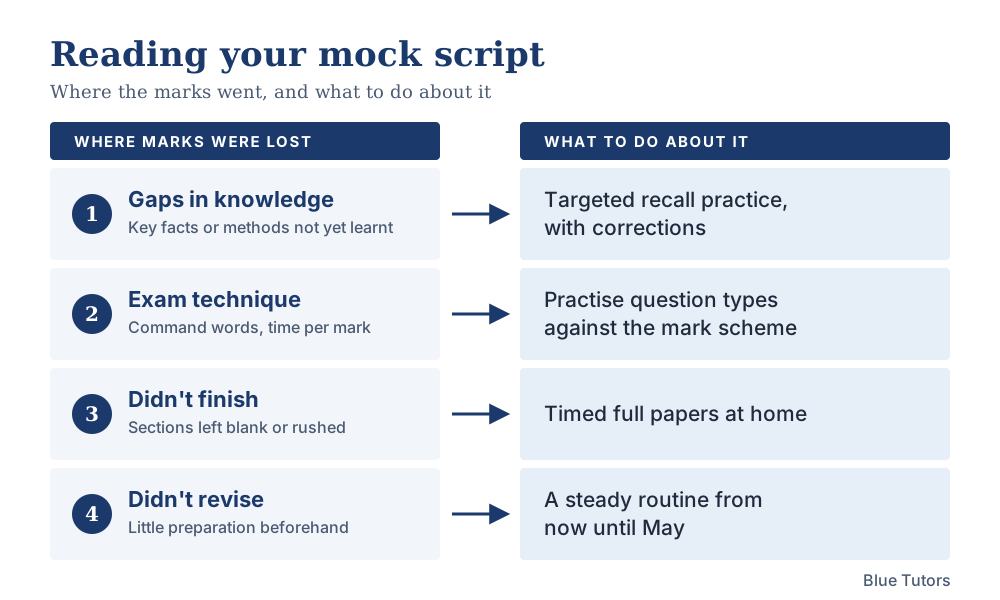
Some marks go because a pupil simply doesn't know something yet: a set of key quotations, the steps in a chemistry calculation, the method for simultaneous equations. This is the most fixable kind of problem. It calls for targeted, repeated practice, and there is solid research behind the idea that trying to recall material, then checking it and correcting the mistakes, does far more for long-term memory than rereading notes ever will.
Other marks go on technique. Your child may understand the material perfectly well but misread a command word, write a paragraph where the mark scheme wanted a calculation, or spend twenty minutes on a four-mark question and run out of time for the big one at the end. Pupils in this group often feel their result was unfair, and in a sense they are right, because the knowledge is there. The good news is that technique is learnable, and usually much faster than content.
Then there are the pupils who didn't finish, or who left whole sections blank. Sometimes that is nerves. Often it is a sign they have never practised a full paper in the time allowed. Either way, calm, timed practice at home during the spring makes a visible difference by May.
Finally, and more often than parents like to admit, some pupils just didn't revise. That is less alarming than it sounds. A mock sat on little preparation tells you very little about what the same teenager can do with three months of steady work, and for many of them a poor grade is the first moment the exams start to feel real. Far better to have that moment in January than in June.
The strongest case against this view
The obvious objection is that mocks do have consequences. Teachers use them as one input for predicted grades, and those predictions feed into sixth form and college applications and, in some subjects, decisions about sets or which tier of paper a pupil sits. A low grade can also knock the confidence of a teenager who was already wobbling, and that is not a small thing.
All of this is true, and none of it changes the argument. Predicted grades are revised as new evidence comes in, and teachers are generally looking at a pupil's trajectory rather than one data point. Summer exam entries, including tiers, are typically confirmed by schools in February, so a clear improvement in the weeks after mocks can still shape those decisions, and it is well worth asking your child's teachers how and when they are made. Most sixth form and college offers depend on the grades achieved in August, not on mocks. As for confidence, it is damaged far more by treating the result as a verdict than by the result itself. A teenager who hears "this shows us exactly what to work on" bounces back much faster than one who is met with silence or a lecture.
Making the most of January to May
Between mock results coming home in January and the first exam on 10 May, there are roughly sixteen weeks, Easter holidays included. That is a decent stretch of time if it has some shape to it. The pupils we see improve most over this period tend to do a few simple things consistently. They go through their mock scripts question by question and make a short list of the topics that cost them the most marks. They tackle those first, rather than starting their revision from page one again. They sit at least one or two full papers per subject under timed conditions before Easter, and mark them against the real mark scheme. And they keep the pace steady, because an hour or so on most evenings beats a frantic fortnight in April.
This is also where one-to-one help earns its keep. A good tutor can read a mock script in the first session and spot patterns that are easy to miss from the inside: the same algebra slip turning up in four different questions, or essays full of good ideas that never quite answer the question set. In a class of thirty, a teacher rarely has time to go that deep with every pupil. A few months of focused sessions can genuinely move a grade, precisely because the work is aimed at what the mock exposed rather than at the whole syllabus.
For parents, the most useful contribution is often the tone you set at the kitchen table. Ask to see the paper. Ask what your child thinks went wrong before offering your own view. Keep the grade in proportion, because it was a practice run, and treat the plan for the next sixteen weeks as the thing worth talking about.
If the results that come home this January are disappointing, try to see them for what they are: a free, early warning, delivered with months still on the clock. Plenty of pupils who do well in the summer had a rough set of mocks. What they did next made the difference.